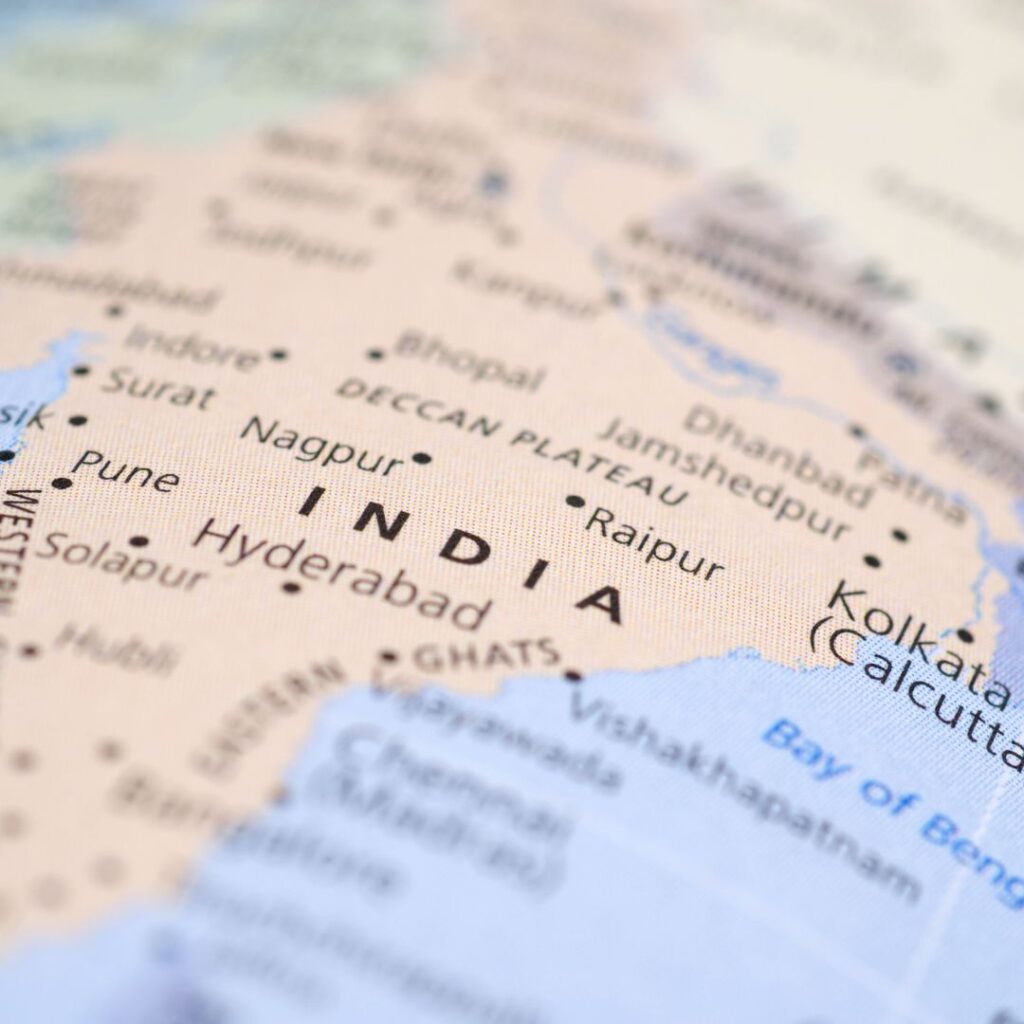
CARTOGRAPHIES OF SKIN : TRAVELLING THROUGH THE TATTOO CULTURE IN NE INDIA

Table of Contents

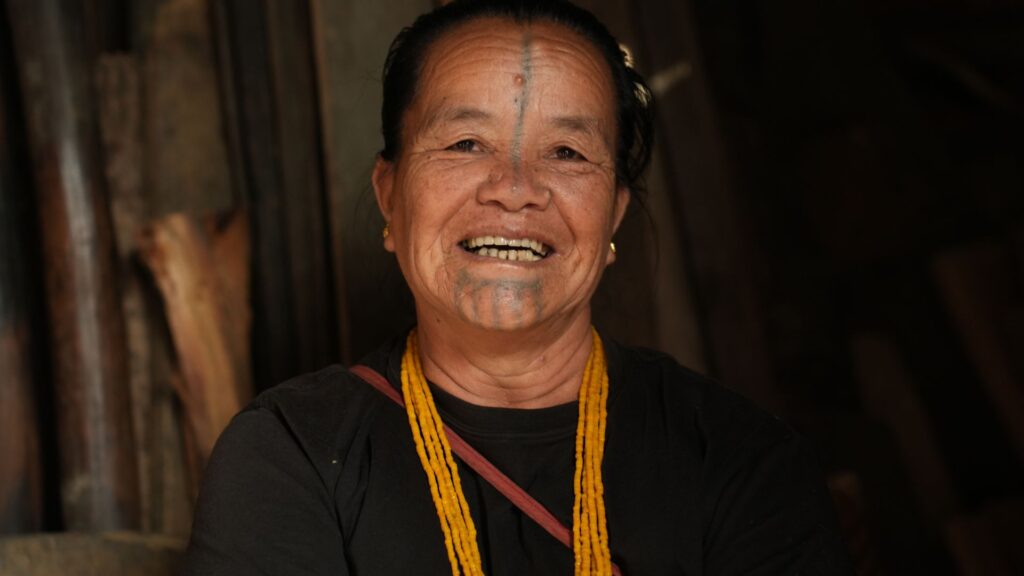
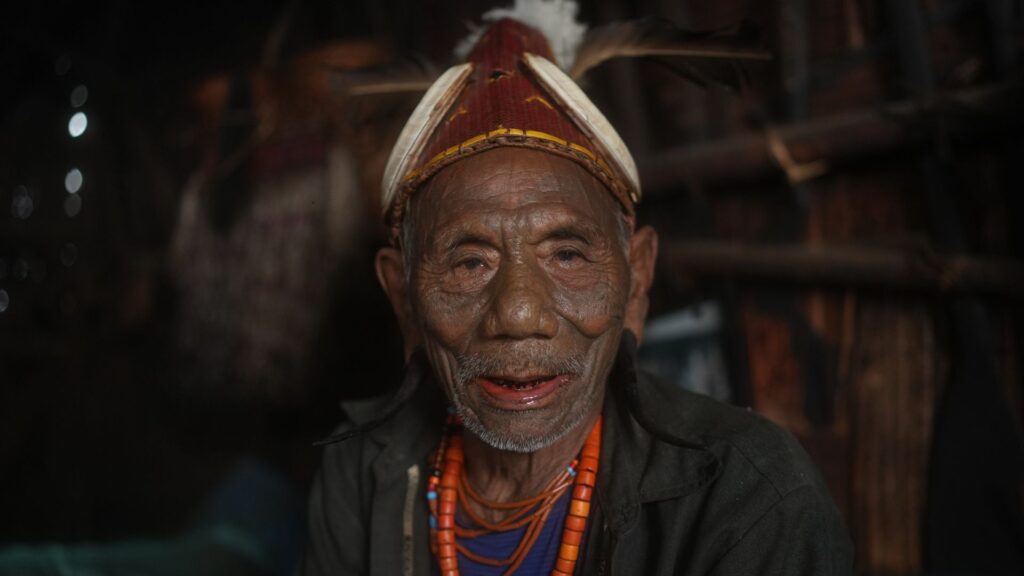
Portrait of smiling tattooed Konyak elder
Stories etched in skin

The First Face You Meet

It’s usually a face that does it.

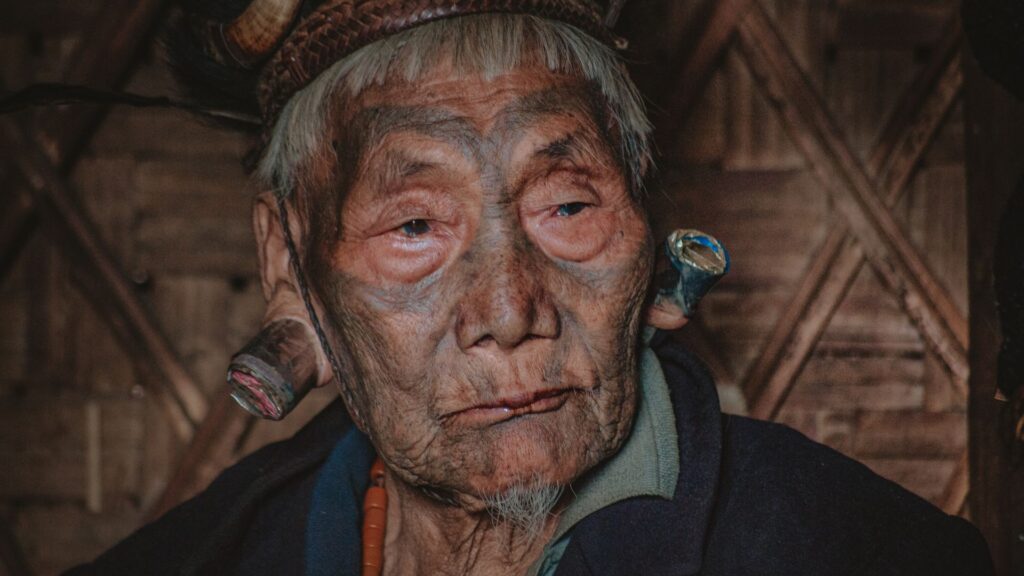
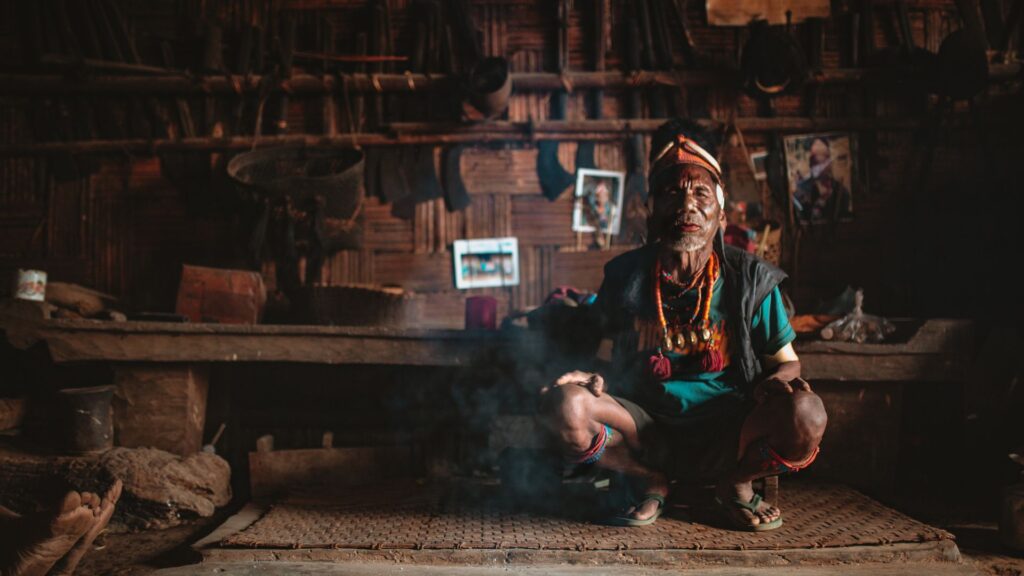
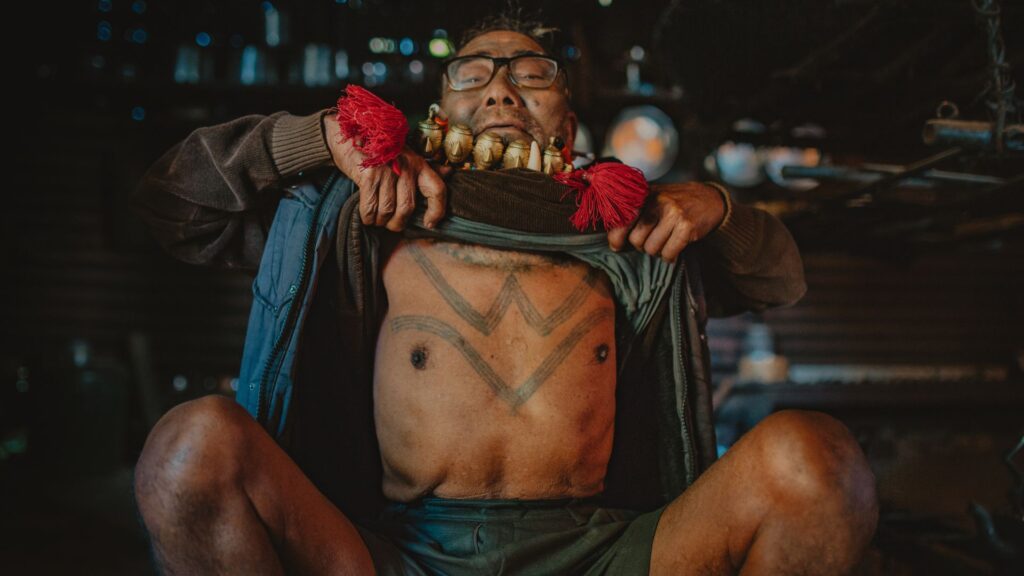
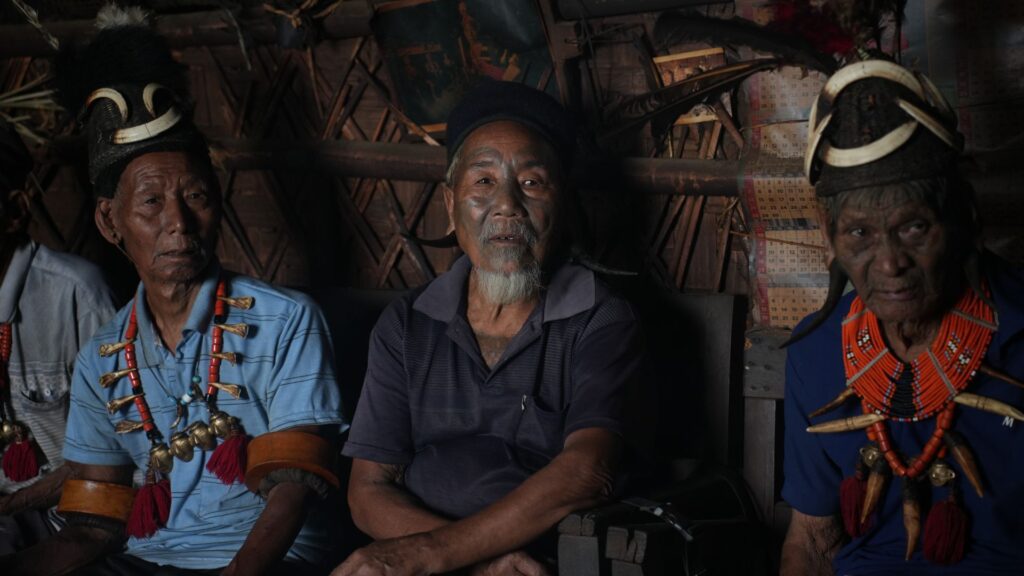
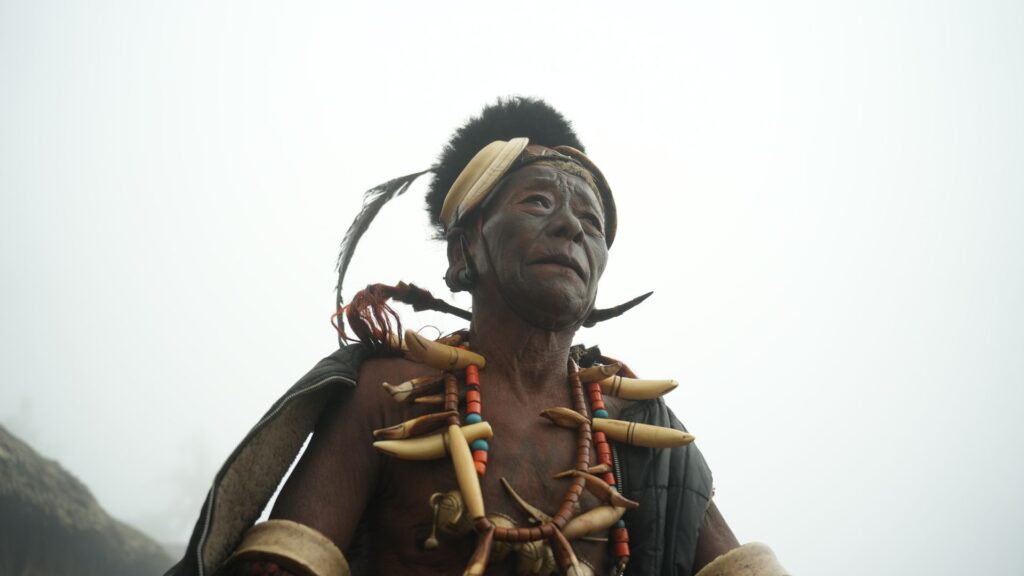
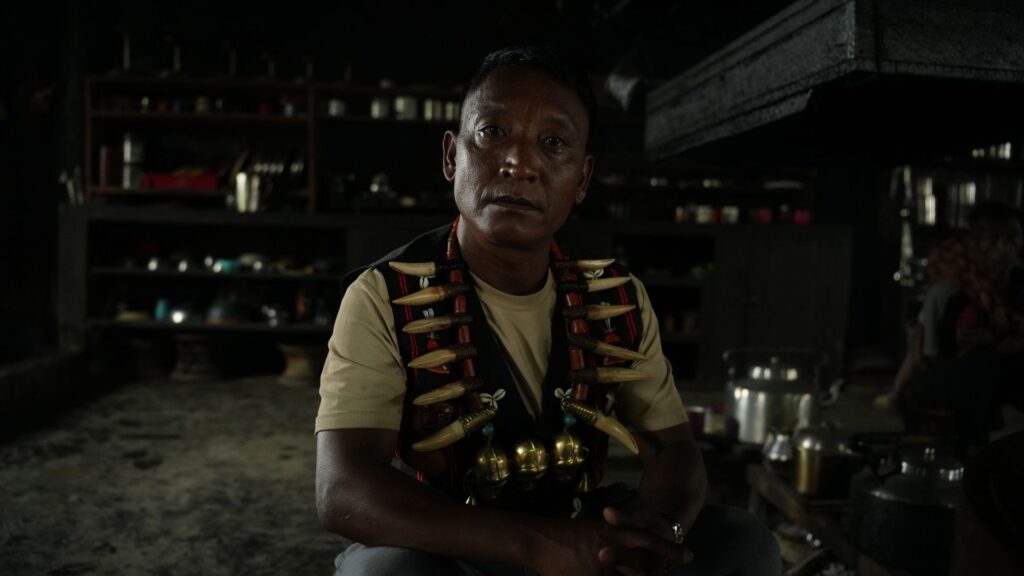
Maybe you’re in Mon, Nagaland, the clouds snagged low on the hills, sitting in a bamboo house that smells of smoke and rice beer. An old Konyak man settles by the fire. His chest is a forest of lines; his face is a dark mask of ink. You realise quietly: this isn’t “body art”. This is a biography.

Portrait of tattooed Konyak elder with ear plugs
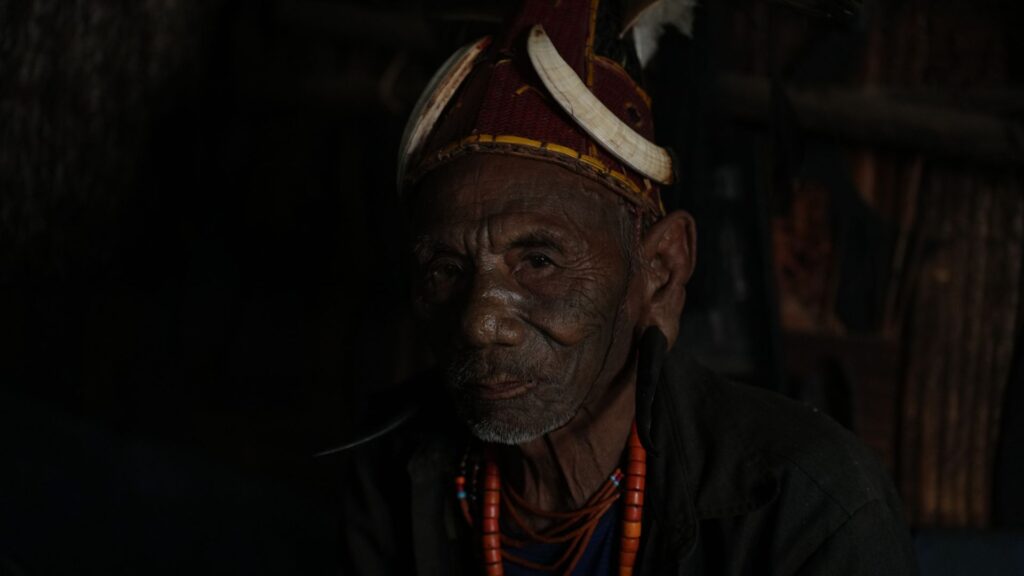
Tattooed Konyak elder

Anthropologist Lars Krutak, who’s spent decades documenting indigenous tattooing, likes to say tattoos are “stories in the flesh,” a way communities remember who they are when nothing is written down. Nowhere in India does that feel more literal than in the Northeast — eight states connected to the mainland by a narrow corridor, but home to well over a hundred tribes and sub-tribes, each with its own designs, taboos and tattoo grammars. 

Travelling here, you’re not just moving through landscapes. You’re moving through a library of skin. 

Konyak elder seated inside bamboo house

Belonging, Written in Ink

On the road from Jorhat to Majuli in Assam, your driver points to an elderly Mishing woman selling vegetables by the ferry. “Look at her hands,” he says. Her fingers are ringed with fine blue patterns, like the border of a handwoven gamosa. She notices you looking, laughs, and lifts her forearms so you can see the full design.

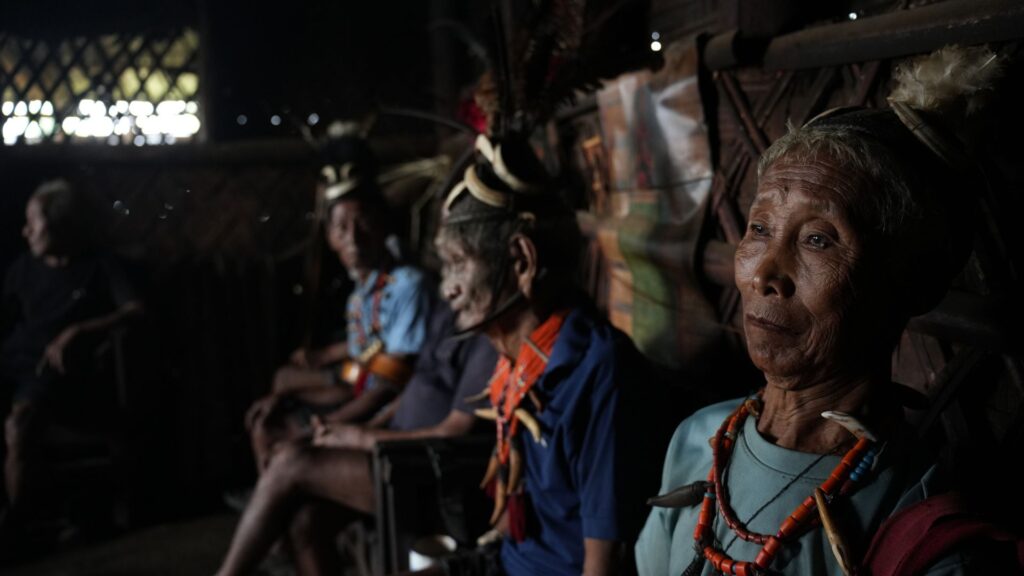
Tattooed Konyak elders sitting in profile
Elders with living histories

“For us,” a young Mishing researcher later tells you over tea, “those patterns said who you were long before Aadhaar cards.” Social scientists studying the region describe these tattoos as “visual biographies” that condense clan identity, age, marital status and ritual history into a single glance.

Across the hills, the logic repeats in different dialects:

  • For some Naga groups, a bare chest used to mean an unproven man; certain grids and bands were reserved for those who had taken heads or hosted great feasts.
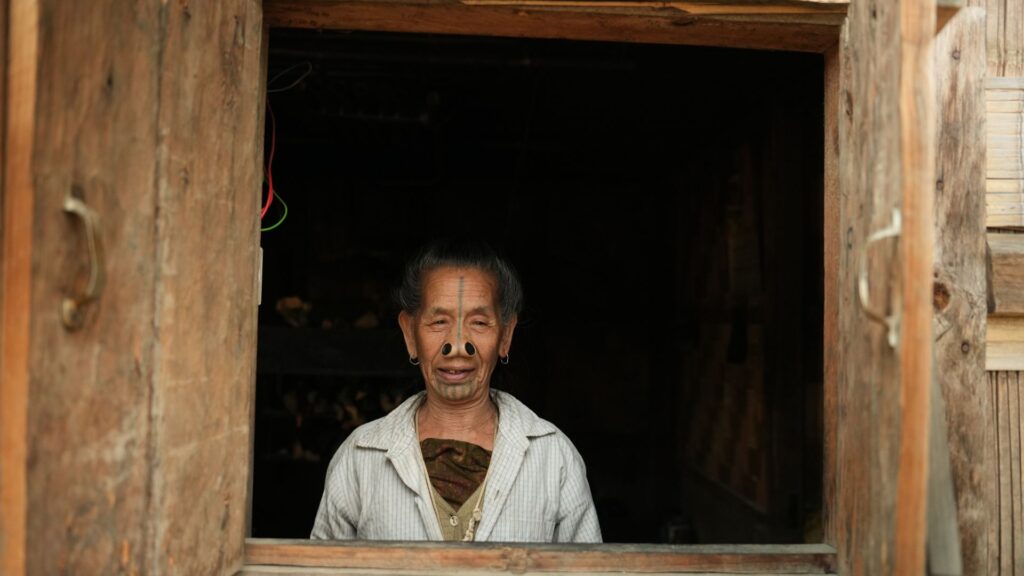
  • Among Apatani women of Ziro Valley (Photo on the left, Source: Word Press), facial tattoos and nose plugs once marked you unmistakably as Apatani — protection in a landscape where raids and kidnappings were real threats.
Konyak elder showing traditional chest tattoos

A walkthrough of all NE, through Ink

Tattooed Konyak elders

Move long enough through the Northeast and you start to see how skin works a bit like a uniform and a family tree at once. In Nagaland’s Konyak villages, the full facial masks worn by elder men once shouted warrior prestige and chiefly lineage — you didn’t just have that face, you earned it through raids, alliances and feasts. Travel east into Wancho country in Arunachal, and dense grids of chest tattoos used to broadcast rank in the village hierarchy, each bar a receipt for some act of bravery or generosity. Swing south to Manipur and tattoos turn more script-like and esoteric, curling along the arms of Meitei dancers and ritual specialists, signalling not warfare but access to gods, stories and ritual knowledge. Head down to the floodplains of Assam, and the marks on Mishing women’s hands are quieter, but no less social: patterns that mirror their woven textiles and say, in effect, “I come from a river world; I make things; I belong to this house.” Up in Ziro Valley, elderly Apatani women carry vertical lines on face and chin that once worked as both clan signature and security measure, marking them clearly as Apatani and, ironically, “uglying” them just enough to deter kidnappers and unwanted male attention.

Portrait of tattooed Konyak elder

What looks to an outsider like “tribal tattoo aesthetics” is really a complex code of who you are and where you sit in the social order. Tattoos sort people by clan, by age, by gender, by class-like distinctions of rank and achievement. They show who had the right to lead a raid or a ritual, who had hosted feasts, who had crossed from girl to woman, who carried sacred texts in their memory. For travellers with no background in the region, this is the exciting part: you’re not just admiring cool patterns, you’re literally reading a moving archive of kinship, labour and power. Every marked body you meet — a Konyak elder, a Mishing grandmother, a Meitei performer, an Apatani matriarch — is a reminder that in the Northeast, identity isn’t only something you state on a form; it’s something you wear publicly, permanently, and in negotiation with your community.

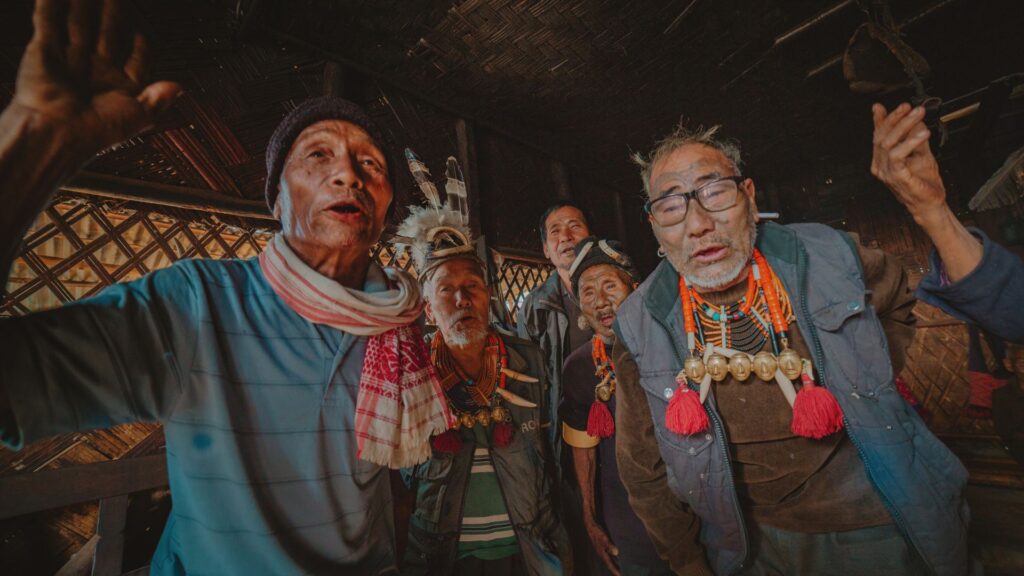
Group of Konyak elders singing together
Voices of the village

Needles of Bamboo, Ink of Soot

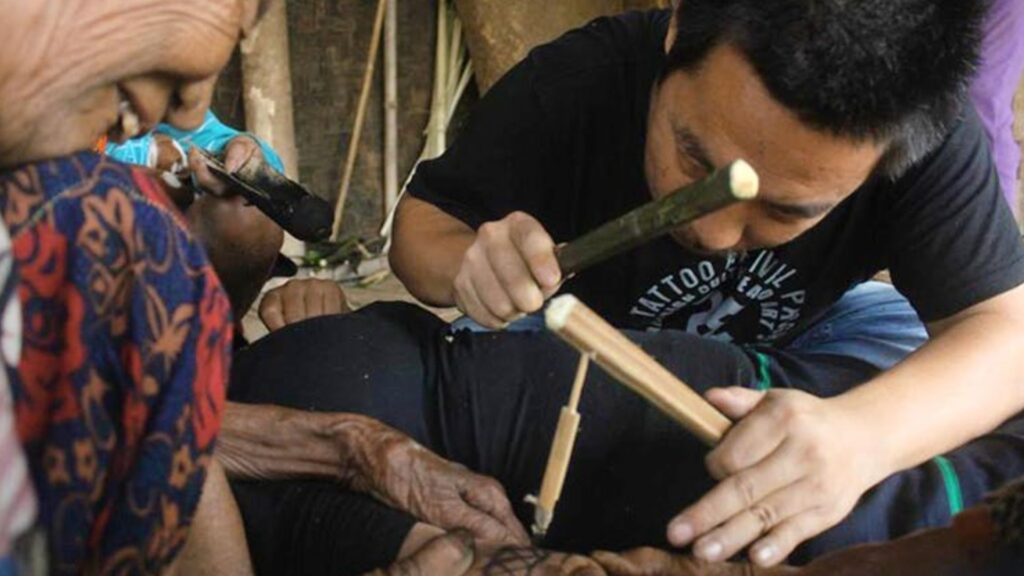
Traditional hand-tapping tattoo process in progress
Hand-tapped tattooing

If you’re lucky, you might stumble into a hand-poked tattoo session at a village festival: no buzzing machines, just a circle of people and the soft tap-tap of thorn or sharpened bamboo slipping into skin. The ink is kitchen alchemy — soot from the hearth mixed with plant juices or fat — guided along charcoal sketches as the tattooist stretches the skin and works dot by dot, line by line. The pain isn’t a side-effect; it’s the test. Sitting still through it once meant you were ready for marriage, for war, for adult responsibilities. 

Apatani chin tattoo
Apatani chin tattoo

In studios across Shillong, Guwahati, Dimapur, Aizawl and Imphal, you’ll now meet 20-somethings who come in asking for designs linked to their grandparents’ villages: an Ao Naga chest motif re-scaled for a shoulder; an Apatani-inspired line pattern reimagined on the forearm; a Meitei script invocation placed where a smartphone once sat.

Apatani woman with traditional facial tattoo at doorway
Apatani facial tattoo

The Quiet Revival: Studios, Scholars and Skin

The story doesn’t end with the last tattooed elders; it twists into a quieter, deliberate revival. In Guwahati and Dimapur, artists like Mo Naga turn their studios into research labs, disappearing for weeks into remote villages, listening to elders, sketching old motifs from memory and museum glass, then reimagining them on the arms and backs of a new generation of Nagas who want their skin to speak their mother’s tongue again. Parallel to them, people like Phejin Konyak — photographing her tattooed grandmothers before they’re gone — and anthropologists such as Lars Krutak, who calls these marks “endangered archives,” stitch the stories into books, films and essays. Together, they form a loose but powerful network of artists, scholars and community custodians, making sure the ink of the future isn’t just decorative, but in conversation with everything that came before.

Konyak elder wearing traditional ornaments outdoors
Tattooed warrior legacy

For Travellers: Ethics of Getting Inked

At some point you’ll probably think, Should I get one too? In the Northeast, that answer comes with fine print. Many designs here are “closed” — Konyak warrior faces, Wancho rank grids, Apatani facial lines — once earned through raids, rituals or life-stage rites, and not really meant to be copied by outsiders (or even younger insiders) who haven’t walked that path. What’s more appropriate is to work with local artists on “open” or adapted pieces: tattoos that borrow from the region’s geometry, flora and layout styles, but are consciously reimagined for today. The simplest rule of thumb: listen first, then ink. Spend time in museums, talk to guides and elders, choose indigenous tattooists, and ask them to design something contemporary rather than replicating a sacred pattern. If you do get tattooed, learn the story and credit the community when people ask. Done this way, the mark you take home isn’t just a cool travel souvenir — it’s an ongoing reminder to treat the cultures that inspired it with care.

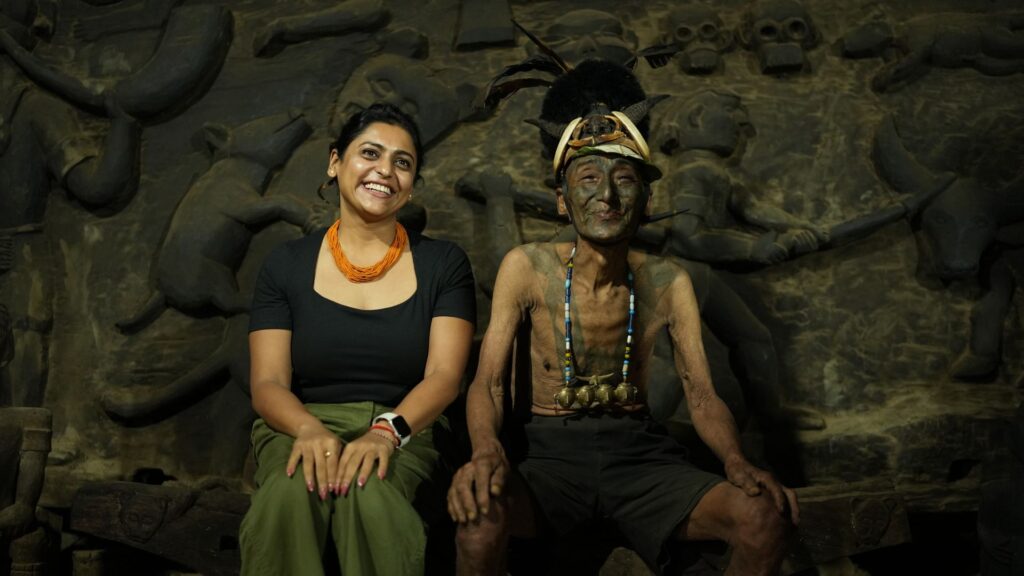
Visitor seated beside tattooed Konyak elder
Sharing space and stories

Where to Learn, Witness and Support

You don’t need to get tattooed to step into this world; you just need to follow the trails where these stories are being kept alive. Start in Shillong at the Don Bosco Museum, then fan out to the small but fascinating state museums and tribal research institutes in Kohima, Imphal, Aizawl, Itanagar and Guwahati, where photographs, jewellery and old portraits of tattooed elders quietly fill in the backstory. Time your trip for festivals like Hornbill in Nagaland or Ziro Festival of Music in Arunachal, where heritage walks, performances and handicraft stalls put you face to face with the people behind the patterns. And in cities across the region — Shillong, Guwahati, Dimapur, Aizawl, Imphal — seek out indigenous-run studios that work with traditional motifs and often collaborate with elders and researchers. Even if you leave with unmarked skin, just sitting in those spaces, listening, watching and paying for the books, art and tattoos that sustain them, is its own way of adding a small line of support to a very long story.

The Angh of Longwa
The Angh of Longwa

Leaving the Hills, Carrying the Stories

On your last evening, maybe you’re back where we began: in a bamboo kitchen, watching the fire seize and fall. The tattooed elder you met on your first day has fallen asleep in his chair, his inked chest rising and falling under a blanket.What stays with you is how normal his tattoos are to the children around him — not exotic, not scary. Just the way their grandfather’s history looks.

In a world where tattoos are often about individual style, the Northeast offers another narrative: ink as collective memory, as proof of belonging, as a way of keeping ancestors and stories close. The revival you’ve glimpsed — in studios, books, museum cases and conversations — isn’t about turning these marks into the next big travel trend. It’s about communities asking: What do we want to remember? And how do we write that on our bodies now?

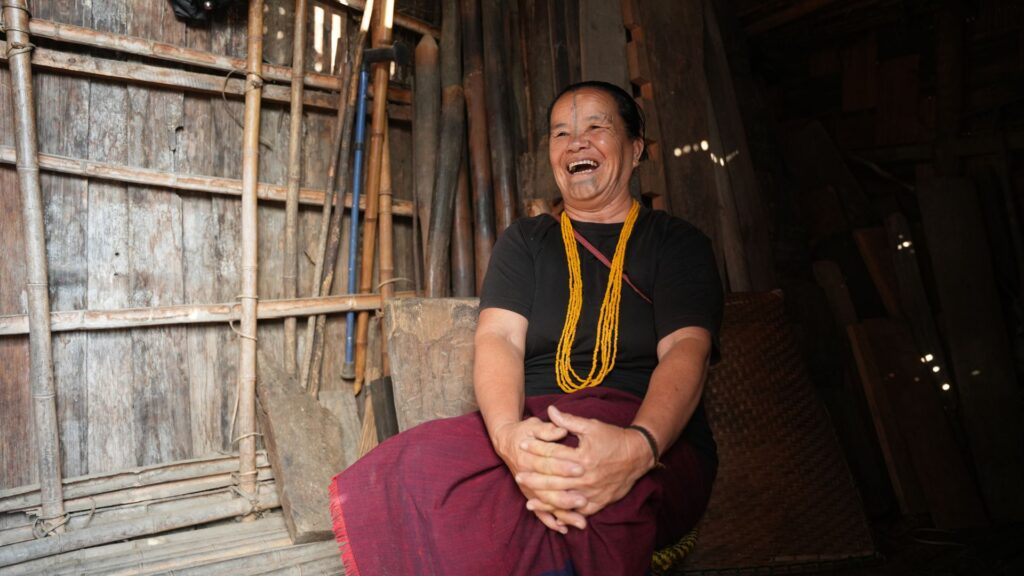
Apatani woman laughing inside bamboo home
Everyday Apatani life

Sources

  • On Konyak tattoo traditions and visual biographies.Konyak, P. (2017) The Konyaks: Last of the Tattooed Headhunters. New Delhi: Roli Books. Roli
     
  • On Naga tattooing, identity and memory (anthropological chapter)
    Krutak, L. (2019) ‘Sacred Skin: Tattooing, Memory, and Identity among the Naga of India’, in Kloß, S. T. (ed.) Tattoo Histories: Transcultural Perspectives on the Narratives, Practices, and Representations of Tattooing. New York: Routledge. Taylor & Francis+1


  • On tattooing, cultural change and Apatani identity (social-science framing)
    Sen, T., Mallick, S. and Kipgen, N. (2023) ‘Tattooing, Cultural Change, and the Indigenous Apatanis of Arunachal Pradesh’, Society, 60, pp. 761–771. doi:10.1007/s12115-023-00869-2. SpringerLink


  • On Apatani women, facial tattoos and chronotope / memory
    Bharadwaj, S. and Boruah, U. (2020) ‘Inking the Identity: A Study of the Apatani Tradition of Tattooing through Bakhtinian Chronotope’, Rupkatha Journal on Interdisciplinary Studies in Humanities, 12(5), pp. 1–6. doi:10.21659/rupkatha.v12n5.rioc1s29n1. Rupkatha+1


  • On Apatani tattooing as intangible cultural heritage (ethnographic + archive)
    INTACH (no date) ‘Tattooing as Folk Tradition Among the Apatani, Arunachal Pradesh’. INTACH Intangible Cultural Heritage Archive. [Online]. Available at: https://icharchive.intach.org/Detail/objects/6466 (Accessed: 15 November 2025).
Picture of Kavya

Kavya

Equal parts policy wonk and wanderlust junkie, Kavya brings together her training in environmental economics and political science with an enduring curiosity about how the world works — and how it could work better. By day, she’s a public health researcher and advocate, working at the intersection of people, systems, and the planet.
Off the clock? She’s a storyteller, active rester, and cat mama.

EXPLORE NORTH-EAST INDIA WITH US

READ MORE ABOUT NORTH-EAST INDIA

Northeast ornaments

Adorned by the Hills – Jewellery of the NE

Tattoo Culture

Cartographies of Skin: Travelling Through the Tattoo Culture in NE India

Flower Valley

Blossoms of the Hills: Exploring the Floral Diversity of Northeast India