INDIGENOUS GAMES OF NORTHEAST INDIA : WHERE PLAY MEETS CULTURE AT THE HORNBILL FESTIVAL
Table of Contents
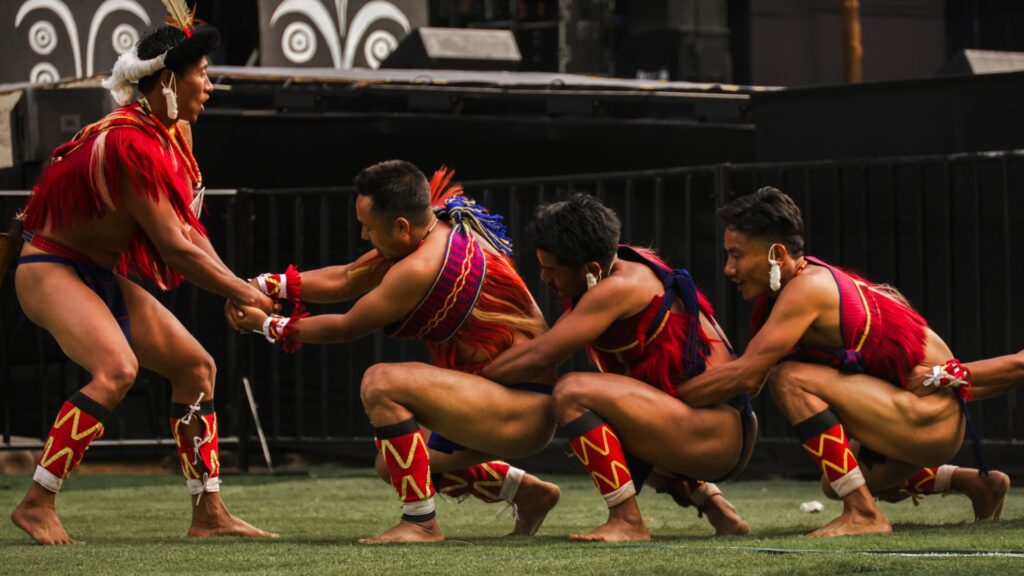
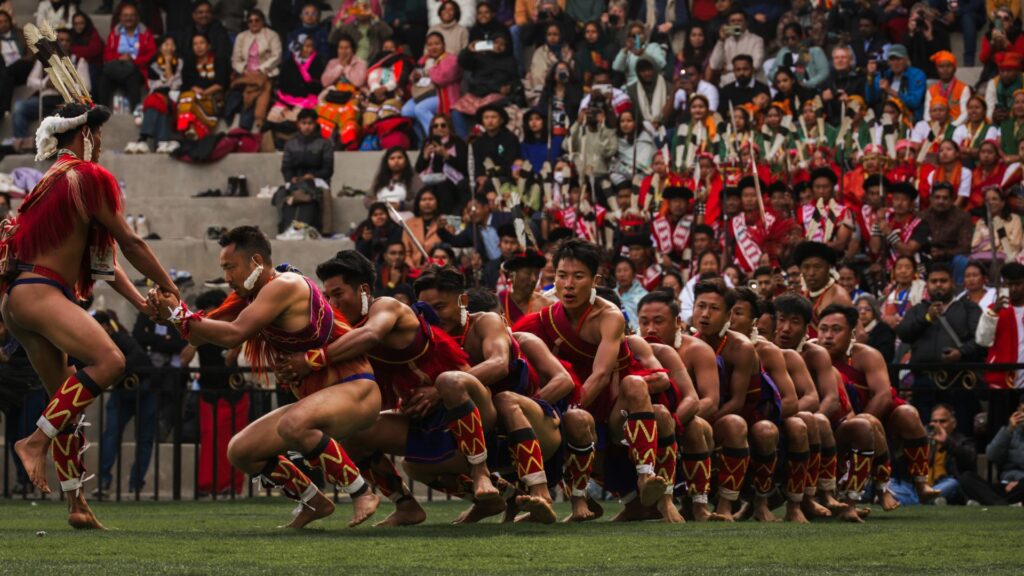
Traditional Naga team game at Hornbill Festival
When travellers dream of the Northeast of India, they often imagine misty mountain villages, emerald valleys, bamboo groves, and tribes adorned in vibrant attire—but hidden within this cultural tapestry is the fascinating world of indigenous games. Far from being mere entertainment, these games are living traditions that once trained warriors, strengthened communities, and marked rituals of survival and spirituality.
Today, the best place to witness—and even take part in—these age-old practices is the Hornbill Festival in Nagaland, a spectacular gathering held every December that unites all sixteen Naga tribes. Here, wrestling bouts echo with pride, bamboo stilt races erupt in laughter as even visitors are encouraged to wobble their way forward, archery contests invite curious travellers to test their aim with bamboo bows, and stone-pulling feats showcase collective strength in breathtaking displays. By opening these games to participation, the festival transforms heritage into lived experience, making it the ultimate cultural adventure for travellers who wish not just to observe tradition but to step inside it.
Games as Cultural Memory
In the tribal societies of Northeast India, games have long functioned as more than recreational diversions. They were, and remain, deeply embedded in the social fabric as acts of pedagogy, ritual, and collective memory. Wrestling bouts or archery contestswere not staged for amusement alone but served as training grounds for warfare, hunting, and endurance in a landscape where survival demanded physical skill and communal solidarity. Performed during harvest festivals and rites of passage, these games inscribed joy into the seasonal cycles of labor and ritual, transforming play into a sacred and social act. To the anthropologist, they appear as “living archives”, repositories where myth, oral tradition, and cultural values are enacted and renewed with each generation. For the intellectually curious traveller, to witness, or better still, to participate in these performances is to move beyond mere observation of culture; it is to enter the arena where history, identity, and play converge in embodied form.
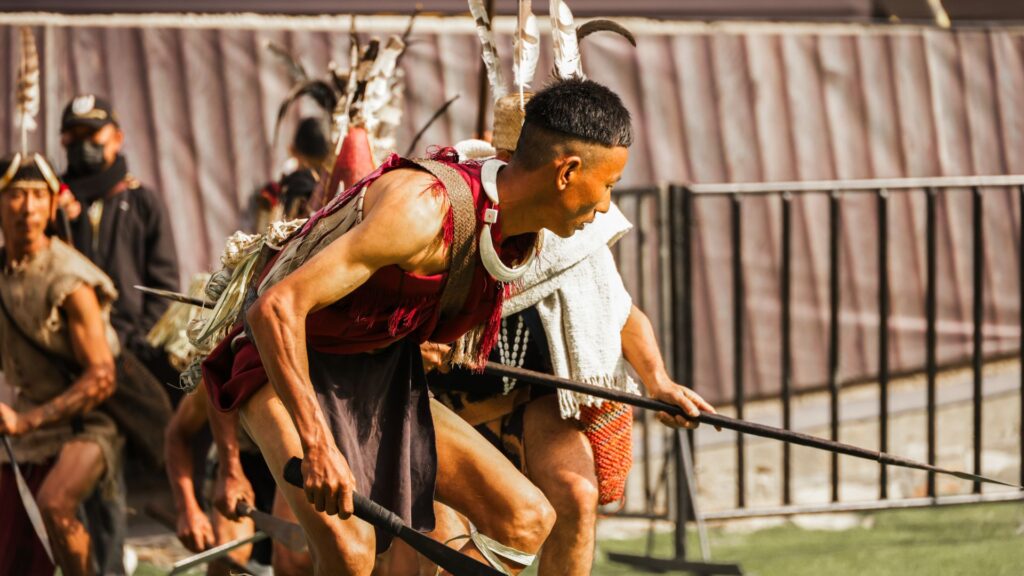
Naga mock combat performance at festival
Wrestling with Honor: Kene
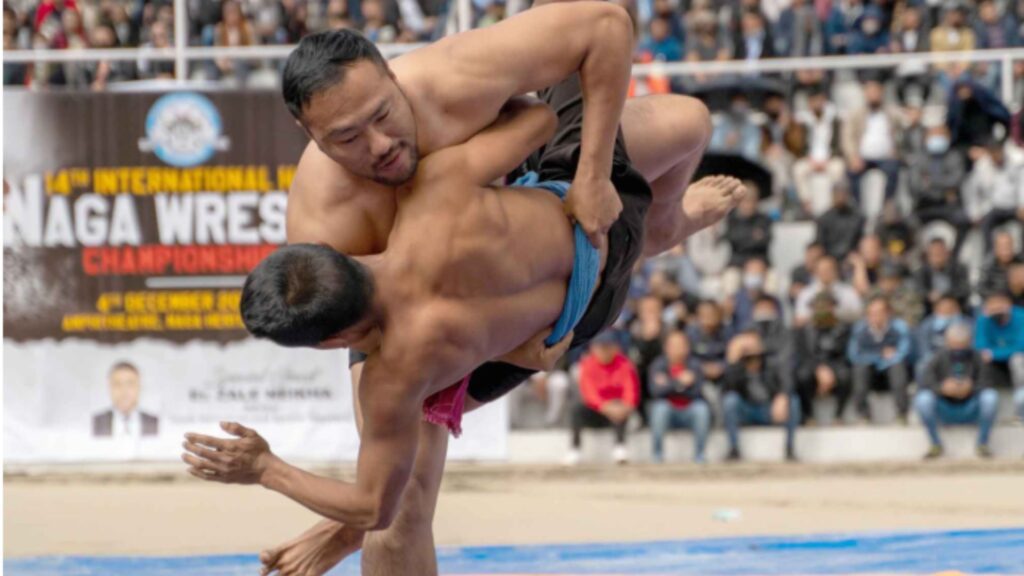
Perhaps the most famous of all indigenous games is Naga wrestling, known as Kene. This is no ordinary bout of strength—it is a performance of identity. Wrestlers, often from the Angami and Chakhesang tribes, face each other in traditional attire, locking limbs in dramatic clashes that test both technique and stamina. Historically, wrestling was more than sport. It was tied to honor, masculinity, and prestige within the clan. Victors were celebrated not just for their physical prowess, but for embodying the virtues of bravery and discipline.
Naga wrestling bout in progress
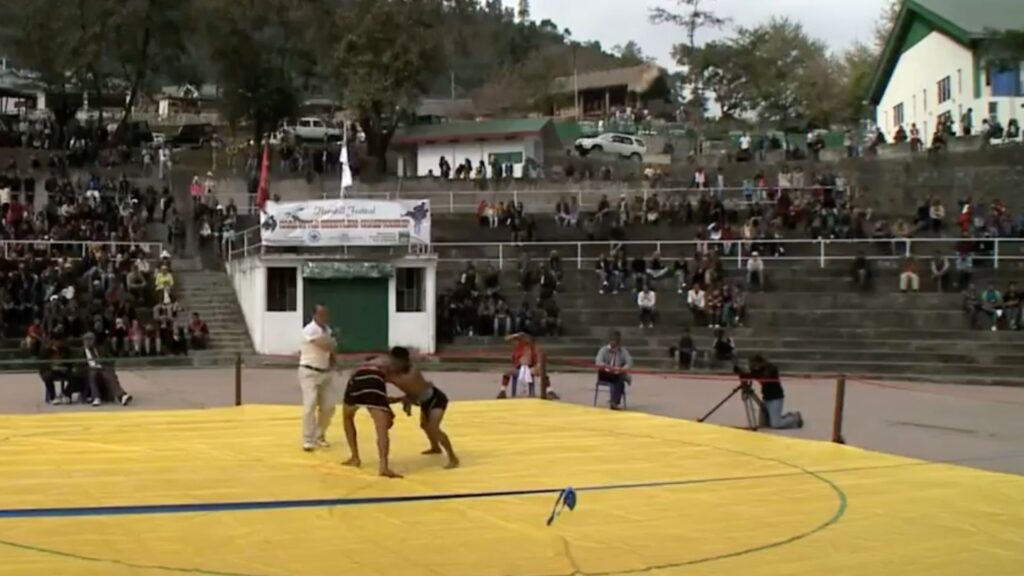
Today, Kene has moved beyond village grounds to become a state-level sport, with organized associations and championships. Yet at the Hornbill Festival, its original essence comes alive again, as the crowd roars with every fall and every lift. For a traveller sitting in the stands, the atmosphere is electric—like watching gladiators in an amphitheater, only this one is surrounded by the Naga hills.
Naga wrestling match in outdoor arena
The Bow and Arrow: From Survival to Sport
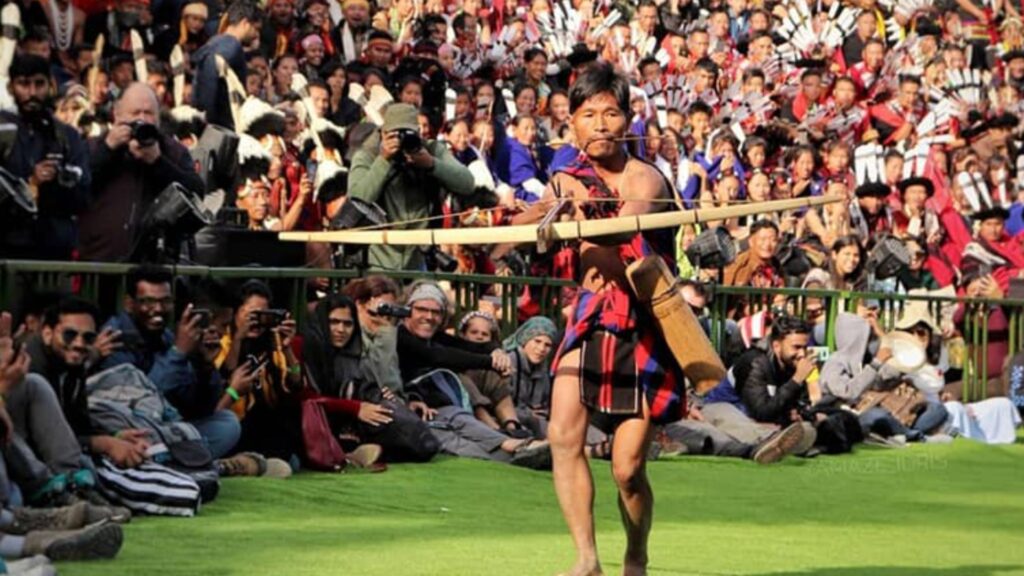
For centuries, bamboo bows and iron-tipped arrows were indispensable tools of survival in the dense forests of Northeast India, where hunting was not just a livelihood but a way of life. Over time, archery evolved into a communal spectacle, to be witnessed during festivals and rites of passage. Among the Ao, Angami, and Lotha Nagas, archery contests were often held during post-harvest celebrations, where men would demonstrate skill not only for prestige but also as a symbolic assurance of protection and prosperity for the clan. The precision of an arrow, in many communities, was read almost like an omen—the straighter the shot, the greater the blessing of ancestors, and the deeper the proof of a warrior’s worth.
At the Hornbill Festival, this age-old practice is given new life. Elderly men, carrying the knowledge of ancestral techniques, stand side by side with younger archers in spirited contests, their bamboo bows bending with the same tension that once decided the difference between hunger and a successful hunt.
Naga archer performing at Hornbill Festival
Unlike wrestling, which remains the domain of trained athletes, archery often welcomes curious visitors. Tourists can draw the bamboo bow, release an arrow, and in that brief flight feel the continuity of centuries—a ritual once vital for survival now reimagined as living heritage.
Feet of Fury: Kick-Fighting Traditions of the Sümi Tribe
The Sümi Naga tribe proudly showcases their unique martial sport, Aki Kiti, giving visitors a rare chance to witness this centuries-old tradition. Unlike wrestling or archery, Aki Kiti is fought entirely with the legs—participants use only kicks to strike, block, and counter, never employing their hands. What unfolds is less a violent clash and more a choreographed contest of agility, rhythm, and precision, often performed in a circular arena with crowds gathered close. Traditionally, this art of kick-fighting embodied the warrior spirit of the Sümi Nagas, training young men in discipline, courage, and endurance while also serving as a festive spectacle during community gatherings. At the Hornbill Festival today, Aki Kiti is demonstrated in its ceremonial form, accompanied by chants and cheering, transforming combat into cultural performance. For travellers, it is one of the most intriguing indigenous games to watch, offering a glimpse into how martial skill and artistic expression merge in the living heritage of Nagaland.
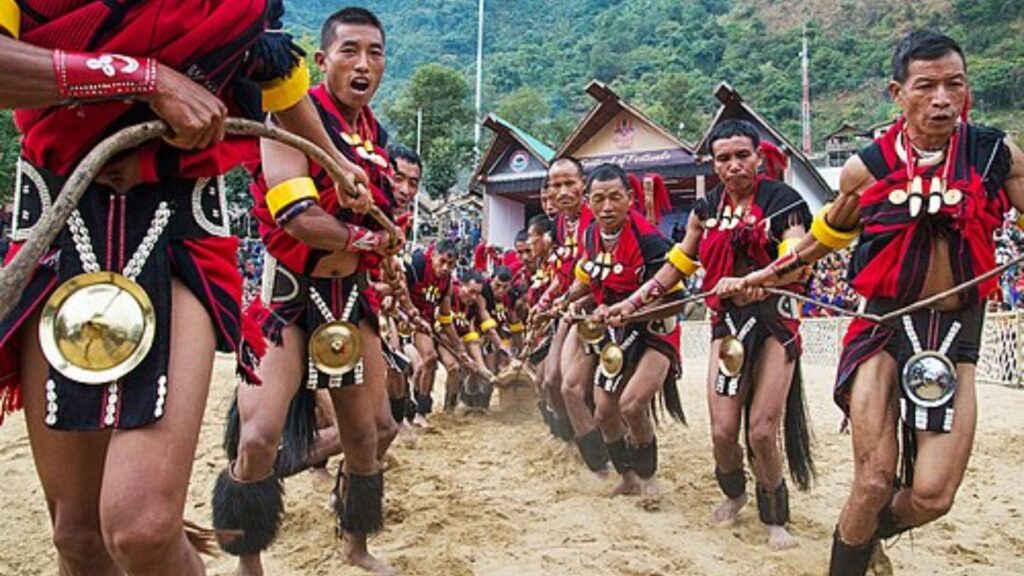
Traditional Naga tug of war contest
Stones That Speak of the Past
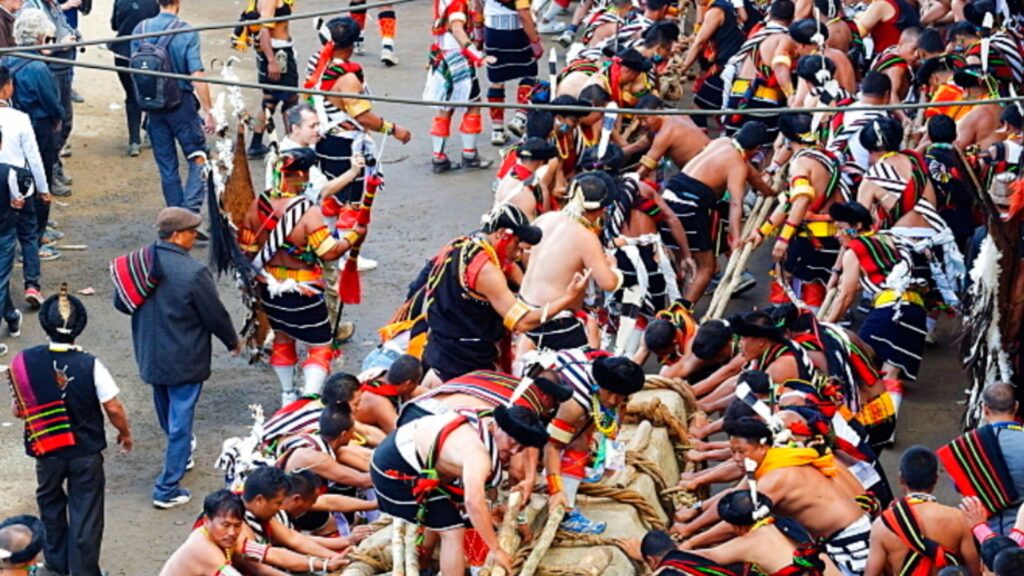
One of the most dramatic and little-known indigenous games is stone pulling. To outsiders, it may seem a simple contest of strength. But for the Naga tribes, this tradition harks back to the megalithic culture of the region, where gigantic stone slabs were hauled and erected to commemorate ancestors or to mark great events. Moving such stones required the energy of entire communities, binding them together in collective labor and pride.
Traditional Naga stone pulling event
At festivals today, stone pulling is performed as a test of endurance and solidarity. Ropes are tied around a monolithic slab, and dozens of men pull in unison while chants and cheers fill the air. Watching this spectacle at the Hornbill Festival is like stepping into a prehistoric memory, where ritual, community, and survival were inseparable. For travellers, it is both awe-inspiring and humbling, a reminder of how heritage can survive in the body’s sheer physicality.
Ritual Combat: The Discipline of Mock Battles
Another fascinating tradition is mock combat, where wooden spears or sticks are used in choreographed battles. These ritualized fights once trained young warriors in discipline and courage. They were also tied to festivals, symbolizing readiness to defend the community. In their modern form, mock combats are less about aggression and more about spectacle, performed with speed, rhythm, and artistry that leave audiences enthralled.
Play Like A Local At The Hornbill Festival
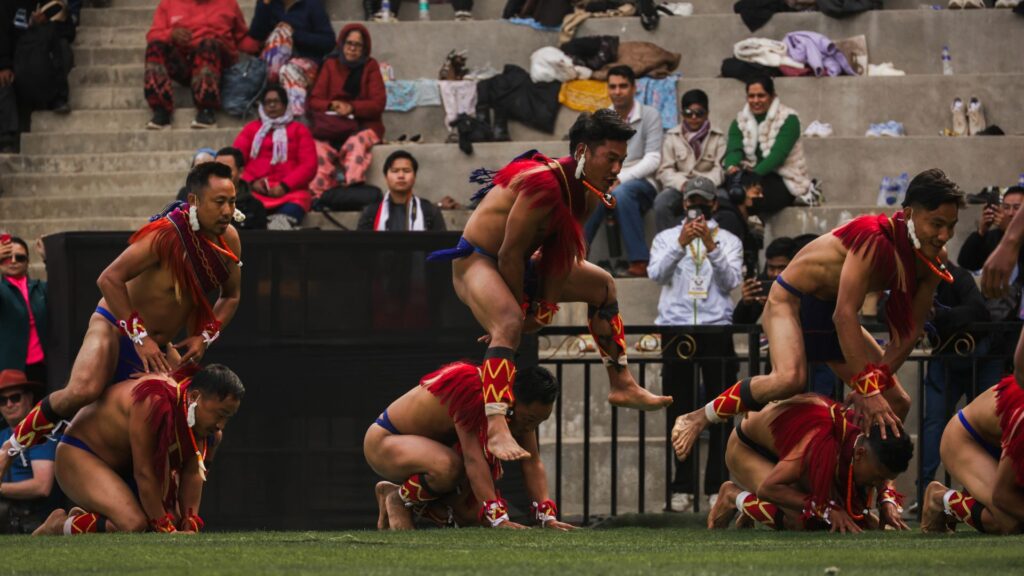
Yep, you read that right. Certain sports are open to visitors and travellers. Beyond archery, one of the most delightful ways travellers can immerse themselves in the spirit of the Hornbill Festival is by joining in bamboo stilt racing, a playful yet skillful sport that tests balance and agility. Traditionally a pastime for village children that later became a festive competition, stilt racing involves mounting tall bamboo poles and racing across uneven ground—an activity that is as hilarious as it is challenging. For tourists, it often begins with a few wobbly steps and inevitable tumbles, followed by bursts of laughter from both locals and fellow participants; the joy lies not in winning but in embracing the shared hilarity of the attempt.
Acrobatic indigenous game performance at festival
Another welcoming game is the tug-of-war, a communal test of strength that pits groups against each other in a good-humored contest of pulling rope and determination. Unlike wrestling or stone-pulling, tug-of-war is intentionally light-hearted, making it easy for visitors to jump in and experience the camaraderie of team play. In both these games, participation is less about demonstrating skill and more about entering into the communal rhythm of the festival. For travellers, joining a stilt race or a tug-of-war is not just an activity; it is a chance to stumble, laugh, and sweat alongside locals, breaking barriers of language and culture through the universal joy of play.
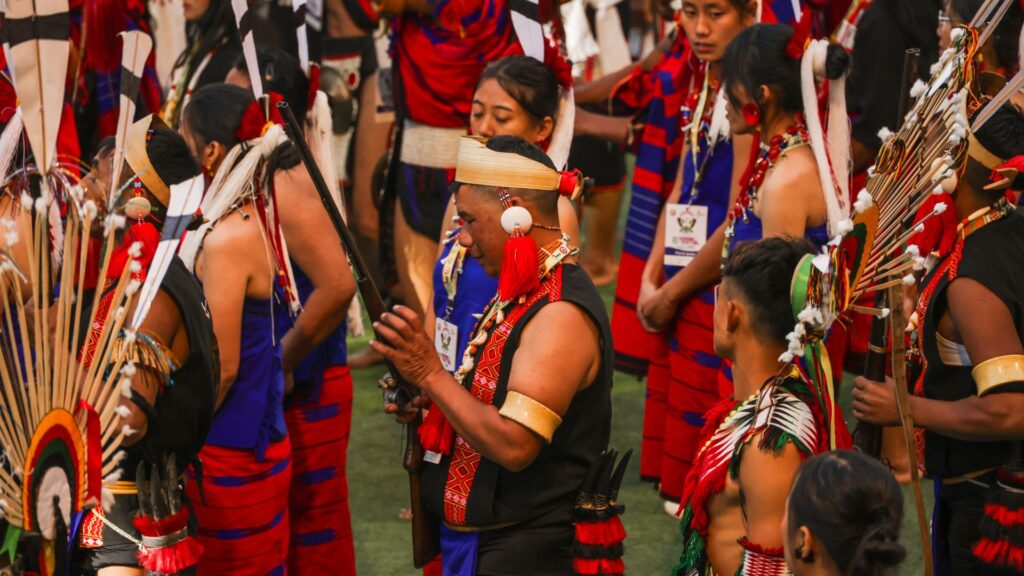
Traditional Naga team performance
The Hornbill Festival: A Living Museum of Play
Every December, Kisama Heritage Village near Kohima transforms into the stage for the Hornbill Festival, often called the “Festival of Festivals.” Here, all sixteen Naga tribes gather to share their music, dance, crafts, food, and, most memorably, their games. For travellers, it is a rare chance to witness and even participate in this cultural mosaic. One moment you may be watching an intense wrestling bout, the next you are laughing through a stilt race or attempting to shoot a bamboo arrow. The festival ensures that these traditions, once fading, are revived not only for locals but for the world to see.
Hornbill Festival participants in traditional attire
Sources
Exploring the Cultural Significance of Traditional Games and Sports Among the Tangkhul Nagas: A Sociocultural Analysis examines how traditional games foster community cohesion and transmit cultural values across generations. Access here.
Educational Implications of Naga Indigenous Games explores how these games function within the education system, reinforcing cultural learning and identity. Access here.
In Cultural‑Recovery and Reformation: Tourism and the Hornbill Festival, the Hornbill Festival is analyzed as a catalyst for revitalizing pride in indigenous culture, evolving from a concocted pastiche into an emotionally resonant cultural form. Access here.
The Kene (Naga wrestling) entry details the sport’s rules, its Tenyimi tribal roots (Angami, Chakhesang, Zeliangrong, Mao, Maram, Poumai), and its formal evolution through organized associations. Access here.
A Humans of North East article highlights indigenous sports at Hornbill—like Naga wrestling, archery, and log cutting—showcasing physicality as central to tribal life and festival appeal. Access here.
The Aki Kiti page provides insight into this semi-contact combat sport from the Sümi Naga tribe, detailing its rules, origins, and revival including demonstrations at Hornbill. Access here.